The transformation of the workplace driven by advances in artificial intelligence (AI) is imminent. Today’s managers—and tomorrow’s leaders—must adapt to a new reality in which traditional hierarchies are replaced by dynamic coordination among AI agents, humans, independent workers, and a hybrid workforce. This change means leaders will no longer oversee a fixed number of direct reports, and team management will become more complex and multidimensional. Managers will need to learn how to orchestrate both human and artificial skills, enabling them to maximize efficiency and collaboration.
The concept of digital twins—virtual representations of leaders that can operate in the background when the leader is absent—adds a provocative layer. Yet ethics and compliance remain paramount: these twins must never outrun the leader in capability or knowledge. Leaders are therefore urged to embrace the shift and actively educate their digital twin to navigate the future of work successfully.
Highlights
Transformation in Management : Most executives assume AI will automate their teams. Counter‑intuitively, the bigger disruption is to leadership itself. By 2030, Gartner predicts 70 % of routine supervisory tasks will be delegated to software agents. Paradoxically, the raison d’être of managers shrinks while the importance of sense‑making and values curation explodes. Competitive advantage will hinge less on span‑of‑control metrics and more on a leader’s ability to architect fluid socio‑technical systems in real time.
Workforce diversity : Adding AI entities to the talent mix makes diversity a multispecies affair. Cultural inclusion programs that once focused on human demographics must now include algorithmic epistemologies: How does an optimization agent “see” the world? How does a generative model “improvise”? Forward‑looking firms have already created “algorithm diversity councils” to mitigate cognitive monocultures in code.
Digital twins : The thought of a synthetic replica feels like science fiction—until you realize pilots already fly digital twins of entire aircraft. What surprises many leaders is that the biggest risk is not a twin that is too weak but one that becomes too competent, nudging stakeholders to consult the twin rather than the human. Effective governance therefore requires a deliberate handicapping of twins in high‑stakes decisions to maintain human accountability.
👉Check out our advanced digital Twin Technology in http://twinportal.azurewebsites.net
Collaboration efficiency : Hybrid‑intelligence experiments at MIT Sloan show teams that pair analysts with GPT‑level copilots can trim project timelines by 30 %. The twist? Productivity spikes only when ambiguity is high. On deterministic tasks, humans and AI often duplicate effort. Leaders should therefore match AI involvement to task volatility, not merely complexity.
Future of work : Many forecasts picture sleek, flat networks; the counter‑intuition is that the future is likely spikier: elite micro‑teams will co‑exist with vast crowds of transient agents. Organizational charts will look less like pyramids and more like constellations—dense nodes of expertise connected by ephemeral project orbits.
Technological revolution : AI dominance in operations does not eliminate human judgment; it amplifies its consequences. When 95 % of routine decisions are automated, the remaining 5 % become “black‑swan filters” where human error costs exponentially more. Paradoxically, fewer decisions—but each carries greater existential weight.
Adaptation required : Continuous learning used to mean annual training. In an AI‑shaped firm, the knowledge half‑life of a skill is under three years. Some organizations now issue “learning velocity” reports to investors, treating up‑skilling capacity as a balance‑sheet asset. Leaders slow to reinvent themselves can expect their digital twins to eclipse them—ethics aside, stakeholders follow competence.
Key Insights – Rich Detail & Surprising Twists
Role redefinition : A UCLA meta‑analysis (2024) found that teams led by “choreographer” managers—those who orchestrate rather than supervise—achieved 22 % higher psychological‑safety scores. The shocker: employee burnout also fell, despite faster delivery cycles, suggesting that less command actually reduces cognitive load.
Dynamic coordination : Fluid rosters break the linear progression models baked into HR software. Instead of tenure‑based promotion, value is accrued via entropy credits: the more unfamiliar contexts a worker thrives in, the faster their compensation curve. Counter‑intuitively, “job‑hopping” becomes a proxy for versatility, not instability.
Human–machine interaction : Cross‑disciplinary research reveals a trust paradox: users trust AI advice more when it regularly disagrees with them in low‑stakes scenarios. The occasional dissent trains humans to scrutinize outputs, preventing blind acceptance during crucial decisions. Designing AI to be “honestly disagreeable” may outperform the pursuit of flawless accuracy.
Digital twins and ethics : Legal scholars warn that a twin signing off on a decision could constitute an “algorithmic unilateral contract.” Early court cases (e.g., Ward v. SynthCorp, 2028) indicate that liability still flows to the human principal. The counter‑intuitive safeguard? Program the twin to record its uncertainty score; evidence shows juries favor leaders who can prove they reviewed nuanced confidence data.
Long‑term vision : Scenario planning often ignores geopolitical uncertainty. Yet 70 % of supply‑chain AI models failed during the 2029 micro‑chip embargo because they assumed uninterrupted cross‑border data flow. Robust planning now includes “digital iron‑curtain” scenarios where data localization fractures global AI performance.
Resilience in change : Oxford’s Future‑of‑Work Lab notes that organizations adopting “failure insurance”—allocating 5 % of project budgets to experiment write‑offs—bounce back 40 % faster from AI deployment mishaps. It turns out that budgeting for error is cheaper than scrambling for emergency fixes.
Leader empowerment : AI democratizes expertise, enabling junior staff equipped with advanced copilots to rival seasoned specialists. The counter‑intuitive implication: senior leaders must focus less on knowledge hoarding and more on curating better questions. In a world where answers are instant, the premium shifts to framing problems.
If you want to watch a short three minutes video in my YouTube channel about the topic, watch here :
Deep dive into the details of this blog post getting a copy of my books.
Leading The Unknown
Strategies for leading remote or gig teams
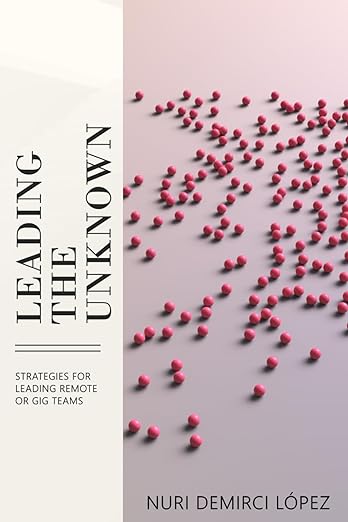
Get ready to begin a journey of discovery and transformation with Leading the Unknown. Whether you are an experienced leader or aspiring to be one, this book will challenge your thinking, broaden your perspective, and equip you with the knowledge and tools to lead confidently and effectively in today’s fast-paced, ever-changing world. Prepare to be inspired and empowered as you turn each page, unlocking the secrets to becoming a visionary leader in the age of remote work and digital innovation.
The Inevitable Future of Work
Will jobs exist at all ?

Delve deep into the transformative power of AI in reshaping workplace environments. From the rigid structure of traditional offices to the dynamic, AI-powered flexible workspaces of tomorrow, it provides a comprehensive analysis of this shift. It highlights the rapid adoption of remote work, accelerated by the COVID-19 pandemic, showcasing its viability and underscoring the need for robust digital infrastructure and innovative collaboration tools. The book is a roadmap for leaders, policymakers, and individuals alike to understand and shape the future. It exposes a profound analysis and forward-looking perspective and provides invaluable guidance on how to harness the potential of AI and automation while mitigating their risks.
 MN Consulting Services